


| Home News/Events Programs Teas Facilities Photo Album About Us Local History Support Us Employment Map/Directions Contact Us |
|
|
 |

|
|
|
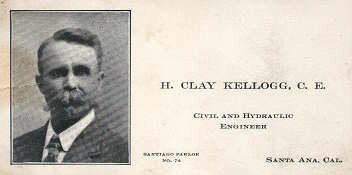
Hiram Kellogg was a native Californian, an uncommon attribute for one of Orange County's pioneers. He was born in St. Helena, Napa County, on September 9, 1855, just six years after California had become a state. His father, Benjamin, had made the migration to California, starting out in a wagon train that included the ill-fated Donner party. When the Donners and a few others decided to try a "new shortcut" to California, Kellogg elected to stay with the main party. He arrived in northern California in time to join Major Fremont at Sonoma and fight in the Mexican War. Benjamin and his wife, Mary Orilla Lillie, had nine children. Hiram was the oldest. When Hiram was 13, the family moved to Anaheim to raise cattle and to engage in the dairy business. Hiram did not follow into his father's business. Instead he opened a sundries shop in Santa Ana with one of his brothers. From this successful business he earned enough money to attend the now defunct Wilson College in Wilmington. He graduated as a civil engineer in 1879 at the age of 24. Until 1883, he laid out vineyards in Anaheim, Placentia, and Pasadena during the heyday of southern California wineries. Hiram's first important engineering job was laying out the town of Elsinore in 1883. For the next ten years he served in several overlapping positions. He was Chief Engineer of the Anaheim Union Water Company and of the Santa Ana Valley Irrigation Company. He was also the Deputy County Surveyor for the County of Los Angeles, which at that time included the area which is now Orange County. He planned the streets of Corona, with its circular "racetrack" made famous by Barney Oldfield, and also became Engineer of the Corona Water System. During this time, he supervised construction of the Pacific Electric railway between San Bernardino, Riverside and Colton. At some point he added Engineer of the Anaheim Irrigation District to his resume. On top of all this, he found time to become Chief Construction Engineer of the Gila River dam at Gila Bend, Arizona. From 1894 to 1899, he was the Orange County Surveyor responsible for many of our major roads and bridges. Joan-Marie Michelsen, Hiram's great granddaughter, remembers a story told to her about one of these bridges. Hiram, without humility, bragged the bridge would last forever. When there was an attempt to tear it down later to make way for a larger bridge, the first attempt failed. The dynamite produced only a "whomp." Another tale told of Hiram was about being chastised for driving on the wrong side of the street. His response was that he "built the (expletive) street and will drive on it any way I please." In 1900 Hiram went to the island of Hawaii, where he built two more dams, creating reservoirs for Wahiawa and Waialua. In 1906, Hiram was appointed Engineer of the Newbert Protection District, making him responsible for flood control of the Santa Ana River from Santa Ana to the ocean. Hiram went by his middle name, Clay. He married twice, the first time to Victoria Schultz. She died shortly after the birth of their only child Victoria Sibyl. His second wife was Helen Kellogg, a very distant relative*. She bore him four children: Helen, Hiram Clay, Jr., Leonard Franklin and Oahu Rose, the last so named in remembrance of Hiram's time in Hawaii. Grandson Ralph Michelsen, remembered Hiram as a loving man who gave Ralph a big hug every day during the year Ralph lived in the Kellogg house. Hiram died in 1921. During his 66 years, he was one of the major contributors to Santa Ana, Orange County and California, along with Arizona and Hawaii. The enduring nature of what he created has added substantially to everyday Orange County life. *They were related through Lt. Joseph Kellogg, born 1624 in Hadley, Massachusetts. Hiram Clay Kellogg descended through Joseph's first wife Joanna Foote. Helen Kellogg descended through Joseph's second wife Abigail Terry. For another look at the Kellogg house and family, see the Santa Ana History site. The Kelloggs Out West site has a good deal of useful information on H. C. Kellogg's ancesters. Although the site is a bit awkward to navigate and has background music on almost every page, the quality of the information makes it well worth a visit. |
© Centennial Heritage Museum 2007
3101 West Harvard Street
Santa Ana, CA 92704
Privacy Policy